

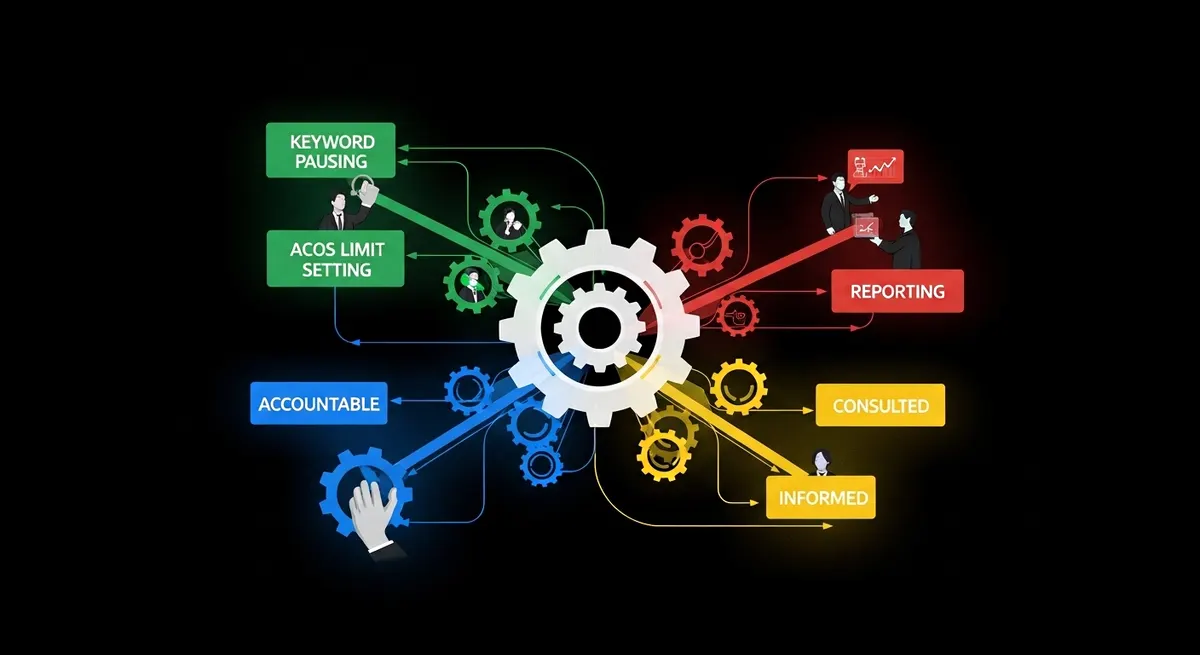
Many Amazon advertisers have their workflows under control – at least as long as the setup remains small and manageable. But at the latest when several people, teams or service providers are involved in the optimisation, central questions arise:
- Who decides whether a keyword is paused?
- Who sets the ACoS limits?
- Who documents why a bid was lowered?
- And above all: who is responsible for what?
This is exactly where a principle comes in that has long been established in classic project environments – and can be worth its weight in gold in the world of Amazon advertising too: the RACI role model. In combination with rule-based PPC control as with PPC-Butler, responsibilities can not only be clearly defined but also implemented efficiently – without misunderstandings and loss of control.
What is RACI and why is it relevant for Amazon PPC?
RACI stands for:
- Responsible (team member – executing) The person or team member who actively carries out the task. There can be several “R”s.
- Accountable (project lead – bearer of responsibility) The person who bears ultimate responsibility for the correct and timely completion of the task. They give the final sign-off. There should be only one “A”.
- Consulted (specialist department – advising) People who must provide input on the basis of their expertise (two-way communication). These are often specialists from other departments.
- Informed (management/client – informed) People who must be informed about the result or the progress of the task (one-way communication).
The model helps to clearly name roles and responsibilities for specific tasks in a project. A RACI model is decisive here for several reasons:
- Avoiding miscommunication and duplicated work: Clarifies who touches which campaign, which keyword or which strategy.
- Speeding up processes: Everyone knows who is responsible for an approval (e.g. budget shift) and who is to be consulted.
- Scalability: When several PPC managers, different departments (e.g. e-commerce, category management) or external clients are involved, RACI creates transparency.
- Risk management: The “Accountable” ensures that no critical actions (such as pausing an entire campaign) happen without approval.
Applied to Amazon PPC, this means, for example:
| Task | R (team member) | A (project lead) | C (specialist department) | I (management/client) |
|---|---|---|---|---|
| Pause keyword when CR is poor | Junior PPC Manager | Senior PPC Manager | Account Manager | Client/management |
| Define rule “ROAS < 3 → lower bid” | Junior PPC Manager | Senior PPC Manager | Account Manager | Client/management |
| Create campaign reporting | Junior PPC Manager | Senior PPC Manager | Account Manager | Client/management |
This clarity is decisive – especially when complex strategies or many participants come into play.
Why role clarity is decisive in automation in particular
With a tool such as PPC-Butler, Amazon campaigns can be controlled in a very granular and flexible way: hourly, daily or on specific events. But the higher the degree of automation, the more important the question becomes:
Who approved which rule – and why?
In ML-based tools (“black-box algorithms”), decisions are often not traceable. If the ACoS suddenly rises or keywords are deactivated, the question remains open: Who was responsible?
With PPC-Butler, every rule is documented, every change traceable. Ideal conditions, then, for establishing RACI-compliant processes:
- “Responsible”: The operational user who implements the rule in the tool.
- “Accountable”: The person who stands behind the decision in professional terms (project lead).
- “Consulted”: Experts who contribute their opinion (specialist department).
- “Informed”: Everyone who should be regularly informed about the changes and results (e.g. client, management).
Practical example: ROAS optimisation with clear roles
A seller wants to achieve an average ROAS of at least 5. The setup is complex, as different product groups and margins have to be taken into account.
Without a clear allocation of roles:
- The employee lowers bids arbitrarily because the ROAS is < 3.
- The client is surprised by the loss of visibility.
- The account manager does not know who did it – or why.
With RACI and PPC-Butler:
- The employee (R) implements the rule: “If ROAS < 3 OR clicks > 20 without conversion → lower bid by 10%”.
- The account manager (A) has agreed this rule with the client and approved it.
- The specialist department (C) was consulted because product margins must be known.
- The client (I) receives the reporting incl. the reason for every application of a rule.
The result: trust, transparency, efficiency.
How PPC-Butler supports RACI-compliant processes
- Documented rule base
Every rule is visible, editable and traceable in the tool – who changed what and when can be tracked exactly. This makes coordination between “Accountable” and “Responsible” easier. - Simulation mode
Before a rule goes live, it can be tested in simulation mode. This allows the “Accountable” to check the effects before the “Responsible” receives approval. - Rule and reporting logic
Rules can be linked to reporting: e.g. “If ACoS > 40% for keyword X → activate rule and send report to account manager”. This maps the “Informed” role directly in technical terms.
Conclusion: structure brings scalability
Amazon PPC is not a one-person game. Anyone who wants to grow – whether as a seller, agency or vendor – needs clear processes. The RACI principle brings order to the system, especially in combination with a rule-based tool such as PPC-Butler.
Because real scalability does not come from more clicks, but from clear decisions, transparent rules and traceable processes.
When every role knows what it has to do, automation does not become a risk – but a success factor.