

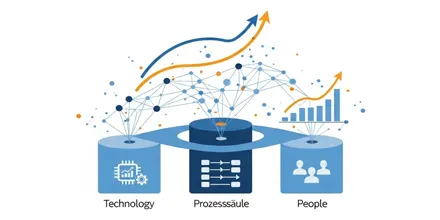
The world of Amazon Advertising is dynamic, complex and highly competitive. Many sellers concentrate exclusively on immediate campaign management: finding keywords, adjusting bids, analysing ad placements. But what if the real lever for long-term success lies not in daily micro-management, but in the creation of a robust foundation? We call this foundation Amazon PPC Mastery.
Mastery is the strategic orchestration of people, processes and technologies to enable scalable, data-driven and profitable advertising activities on Amazon. It is not about whether you start a Sponsored Products campaign, but how you build an entire ecosystem that supports your advertising seamlessly, efficiently and with agility.
In this article we examine the three essential pillars of a successful Amazon PPC strategy and show you how to implement them in your company.
Pillar 1: Technological enablement – your toolbox for efficiency
Managing hundreds of campaigns manually is not only time-consuming, but also prone to error. The right technology is your force multiplier.
- Amazon native tools: The first step is mastering Amazon’s own tools. Amazon Advertising Console is your operations hub. For deeper insights, Amazon Brand Analytics (only for Brand Registry holders) is indispensable. Here you will find valuable data on search terms, market shares and your competitors’ customer access.
- Third-party software & automation: This is where you unlock the full potential of your PPC management. Tools such as PPC-Butler automate repetitive tasks such as keyword research, bidding or the creation of search term reports. They also offer advanced analyses and visualise key figures (KPIs) in a way that is hardly possible in the native console. This automation frees your team from manual work and enables it to concentrate on strategic decisions.
- The interface to IT: Make sure that your advertising tools can communicate seamlessly with other systems such as your ERP, CRM or your business intelligence (BI) platform. Automated data transfer between these systems creates a single source of truth for your performance data.
Pillar 2: Process enablement – the roadmap to scaling
Consistency and repeatability are the cornerstones of growth. Without clear processes, every team member acts at their own discretion, which leads to inefficiency and errors.
- Standard operating procedures (SOPs): Document your procedures! Create detailed SOPs for central tasks:
- Onboarding new products into the advertising strategy
- Structuring and naming campaigns
- Regular keyword research and negative keyword strategy
- Analysing performance reports and deriving measures
- Workflows & responsibilities: Define clearly who is responsible for which task (RACI matrix). Who is responsible for creating campaigns? Who analyses the key figures every week? Who is authorised to adjust budgets? Clear workflows avoid overlaps and ensure that nothing falls through the cracks.
- Test and learn cycle (Test & Learn): Establish a rhythmic process for experiments. Whether A/B tests for ads, different creatives or bidding strategies – a structured test cycle ensures that you learn continuously and optimise your campaign performance. Document the results of every test, regardless of the outcome, in order to build a valuable knowledge base.
Pillar 3: Human enablement – your team as the heart of the strategy
The best software and the most sophisticated processes are worthless without a team that understands them and uses them effectively.
- Training & knowledge management: The Amazon landscape is constantly changing. Invest in the continuous training of your team. This can be done through internal training, attending webinars (such as those from Amazon itself) or taking part in industry-leading conferences. Create an internal knowledge hub in which training materials, SOPs and best practices are stored.
- Promoting a data & testing culture: Enable your team members to make data-driven decisions. Instead of acting on gut feeling, the question “What do the data say?” should take centre stage. Encourage them to develop their own hypotheses and to test these within your test and learn cycles. This personal responsibility increases motivation and leads to more innovative solutions.
- Collaboration across departmental boundaries: Amazon PPC is not an island. The closest collaboration is with Category Management (for product data and listings) and the supply chain/logistics team (for stock levels and shipping performance). A high-performing listing is the basic prerequisite for PPC success, and stock that is running out makes every ad worthless. Regular coordination is crucial.
Your way forward
Building a comprehensive Amazon PPC Mastery strategy is not a one-off project, but an evolutionary journey. It begins with taking stock: where do we currently stand in terms of tools, processes and knowledge?
- Audit your current status quo in all three pillars.
- Identify the biggest weaknesses and levers.
- Prioritise the measures that promise the greatest impact for a reasonable effort.
- Implement the changes step by step and communicate them clearly to your team.
- Measure success using overarching KPIs such as overall profitability (TACoS), efficiency gains (time spent per campaign) and scalability (growth of advertising activities without linear growth in staffing effort).
A strong strategy transforms your Amazon PPC management from a purely operational task into a strategic competitive advantage. You not only create successful campaigns, but build a system that makes success consistent, measurable and scalable.