

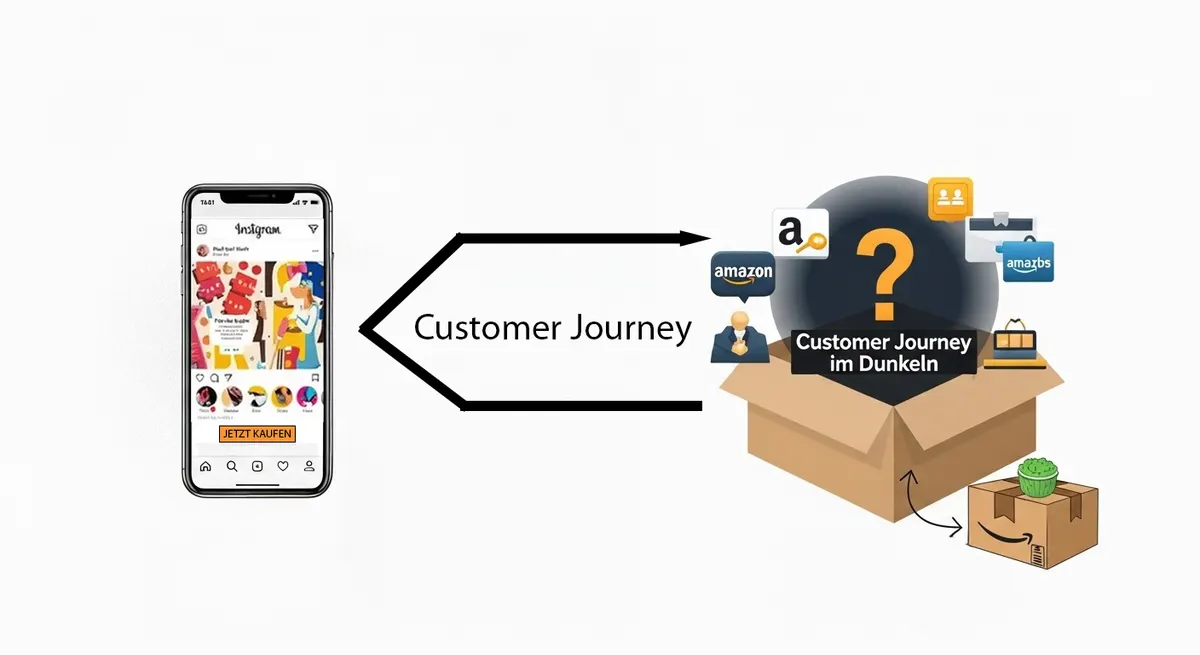
Ask yourself these questions: What role do my Facebook campaigns really play in my Amazon revenue? Does the new newsletter actually bring buyers to the product page? And how do my display banners perform compared with paid search ads?
If you have so far only been able to answer these with a shrug, you are not alone. For marketing outside the Amazon ecosystem, the data was often thin – a blind drifting in which you had to rely on your gut feeling. But that changes fundamentally with a tool called Amazon Attribution.
But what is behind it? Is it just another analytics tool, or the key to a holistic marketing strategy? In this article, we get to the bottom of the matter.
The basic principle: from “dark social” to a clear picture
Put simply, Amazon Attribution is a measurement and analytics tool that allows you to track the performance of your off-Amazon marketing channels (such as Facebook, Google Ads, influencers, email) directly in your Amazon Advertising account.
The classic case: a customer sees your product in an Instagram post, clicks the link, looks at it on Amazon, but may only buy it two days later via an organic search. Without attribution, this customer journey disappeared into nowhere. Amazon Attribution prevents exactly that by giving the click on your Instagram link a unique identifier (a tracking pixel). Every resulting order is attributed to the original click.
Why is this a game changer? Three concrete advantages for your business
- Data-based budget allocation: an end to guessing
You no longer have to guess which channel delivers the best ROAS (Return on Advertising Spend). You see in black and white whether your Pinterest campaign actually generates conversions or whether your budget in the Google Display Network would be better placed with YouTube. This allows you to withdraw budgets from poorly performing channels and put them into the true drivers of your revenue. - Understanding the customer journey holistically
Buyers rarely come to you via a single channel. With Amazon Attribution, you trace the complete path. You see how your brand-building activities on Facebook ultimately influence the conversion rate of your Amazon PPC campaigns. This deep understanding enables you to coordinate your channels synergistically with one another. - Fuelling Amazon’s algorithms
Every click tracked from outside signals to Amazon’s A9 algorithm: “This product is relevant and in demand!” This can have a positive effect on your organic ranking and increase the effectiveness of your internal PPC campaigns. You feed the machine with valuable data.
How to put Amazon Attribution into practice: step by step
Using it is surprisingly uncomplicated once you have access (provided you are a vendor, seller or agency with the appropriate permissions).
- Create a campaign: Within the Amazon Attribution dashboard, you create a new “folder group” for a specific product or product group.
- Generate tracking links: For each of your external channels (e.g. “Newsletter March”, “Facebook Carousel Ad”, “Influencer XY”), you generate an individual tracking link.
- Insert the links: Replace the plain URLs in your marketing activities with these special Attribution links.
- Evaluate the data: After some time, you will see a wealth of metrics for each channel in your dashboard: clicks, detail page views, add-to-carts and – the decisive point – units sold and the total revenue generated.
A word of caution: the attribution model
At this point, there is an important technical nuance to note that is often overlooked. By default, Amazon Attribution works with a last-touch model. This means: the last tracked click before the purchase receives the entire attribution.
Example: A customer first clicks on your Attribution link in the newsletter, then a day later on one of your Amazon Sponsored Brands ads. Because the click on the Amazon ad was the last one before the purchase, it receives the entire conversion credit – the newsletter comes away empty-handed, even though it provided the decisive first impulse.
Our recommendation: Log your campaigns meticulously in order to understand these overlaps. Do not see Amazon Attribution as the sole truth, but as a powerful piece of the puzzle in the overall picture of your analytics.
Conclusion: tear down the silo walls of your marketing
Amazon Attribution is far more than a pure tracking tool. It is an invitation to think about your marketing holistically. It ends the era of silo thinking, in which Amazon PPC, social media and email marketing operated in separate worlds.
By closing the gap between off-Amazon and on-Amazon marketing, you gain not only efficiency but also strategic impact. You can finally prove on a sound basis which part of your marketing really drives the growth of your Amazon business.